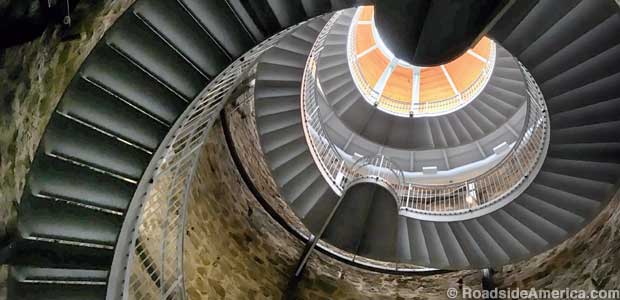
Looking up from below, the Big Well's spiral staircase circles skyward.
The Big Well

Greensburg, Kansas
For over 50 years the "World's Largest Hand-Dug Well" was just a big, rock-lined hole in the ground, 32 feet wide and 109 feet deep. It was dug in 1887-88 by men using picks, shovels, a pulley and rope, and half a barrel to haul up the dirt. A staircase and lighting were added in 1916, but it wasn't until 1939 that the Well was opened to tourists, who would pay for the adventure of walking down to its dank bottom.
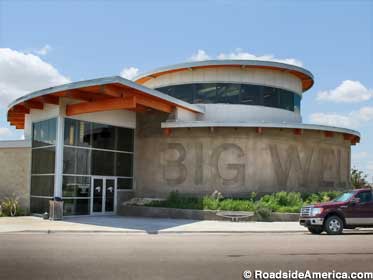
The Big Well's vortex building design was inspired by the tornado that flattened its predecessor.
Ten years after The Big Well opened to the public, the World's Largest Pallasite Meteorite -- discovered by a local farmer with a giant home-built metal detector -- was added to the Well's above-ground gift shop as a bonus attraction.
And that's basically how things stayed until May 4, 2007. That was the day that everything around The Big Well -- not just the gift shop but the entire town -- was blown to smithereens by a mile-wide mega-tornado.
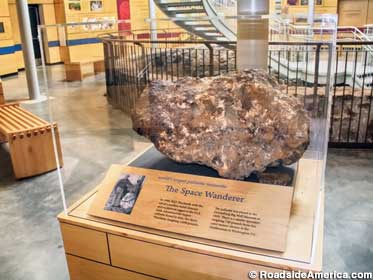
Meteorites, tornadoes... the angry skies of Greensburg.
Eleven residents died in the horror, but the below-ground Well suffered minimal damage, and the meteorite was one of the few things that survived obliteration of the gift shop. Greensburg mourned its dead, shook off its dust, and rebuilt itself as a "model green city." And after five years The Big Well reopened, now encircled by a museum dedicated to telling the story of the town and its disaster.
Driving into Greensburg to see The Big Well is an in-your-face reminder that you're in deadly twister territory. The little town is an odd mix of state-of-the-art green buildings and empty lots filled with weedy rubble. The Big Well Museum alone cost $3 million, and was designed as a vortex, with a new spiral staircase for the Well, so that it would suggest a tornado.
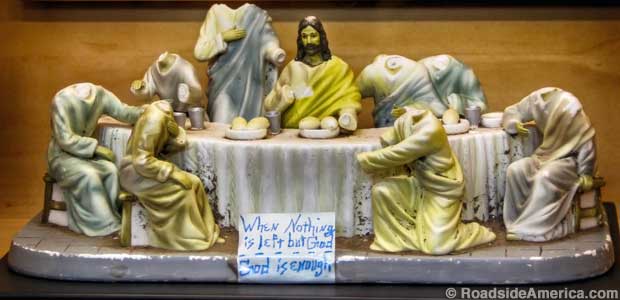
Jesus was unfazed by the twister. His disciples, however, lost their heads.
On the ground floor, displays recount the history of The Big Well and the giant twister. Vintage Big Well souvenirs -- obviously elsewhere when the storm hit -- are exhibited along with significant debris such as the town's wrecked tornado siren and a clock stopped at the moment that Greensburg was destroyed. The poor meteorite, a star in any other small town, has fallen to a distant third place in the reasons-to-visit-Greensburg museum's hierarchy.
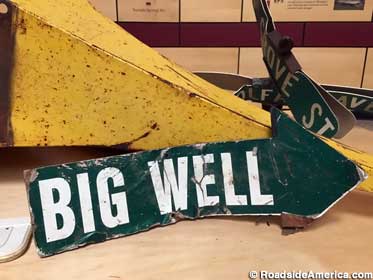
Greensburg's old safety yellow tornado siren is now part of its museum's wreckage display.
Despite the Big Well Museum's new slick and serious veneer, the main attraction remains the odd thrill of walking down into The Big Well. Its interior is cool and humid; its bottom disappears into the local aquifer. Tiny balconies at various points along the spiral staircase allow visitors to lean in and look straight down without risking a fall -- although any dropped smartphones or cameras are goners. The bottom of the Well, as was the case before its remodeling, is littered with loose change. If you lean in too far while standing at the bottom, you may be conked by a penny hurled from above.
In the gift shop, chunks of the Well's old staircase are sold as souvenirs. We remember standing on it during an earlier visit when the town's tornado siren went off -- the same one now displayed in the museum -- echoing weirdly off of the Well's circular stone walls. Back then it turned out to be just a test -- but if another monster tornado does strike Greensburg, there's probably no safer place to be than down in The Big Well.

 Political Art of M.T. Liggett
 Backyard Carousel
 Midway USA