
An angel for every crew member and passenger (minus the terrorists, of course).
Flight 93 Temporary Memorial (Gone)

Shanksville, Pennsylvania
This report is about the ad hoc memorial on the crash site from 2001-2011, replaced with the official Flight 93 National Memorial.
There's no question that the Flight 93 National Memorial is where the War On Terror began.
Until Flight 93 came down at 10:06 am on Sept. 11, 2001 -- a result of passengers fighting hijackers for control of the plane -- America had just been a VICTIM of terror. Not here in Shanksville, pal. In this part of central Pennsylvania the abundance of homemade "Let's Roll!" signs and bumper stickers echo the prevailing sentiment that the Flight 93 Crash Site marks the spot where America started taking action.

The national memorial in Shanksville stirs powerful emotions in nearly all who visit. It's in the middle of an open field, miles from the nearest town, and many miles from the nearest freeway interchange or Starbucks.
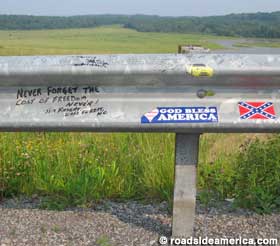
For years the memorial was ad hoc, created by the people -- like a highway fatality shrine that had been given its own parking area and porta-potties. A small open shed held a guest register and scrapbooks of photos and news clips. A length of hurricane fence held hats, photos, poems, homemade signs. Metal guardrails around the parking lot were covered with patriotic bumper stickers and Sharpie scrawls -- pledges of remembrance, vows of revenge, prayers from appreciative citizens. A slew of personal messages were taped to rocks, photos, and just scattered in the grass.
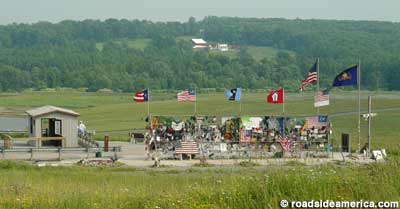
Flight 93 temporary memorial.
That began to change in 2009 when the National Parks Service broke ground for an official national memorial at the site. The design had taken years to iron out, at one point generating controversy because of a perceived Islamic crescent in the layout.
Dedicated on the tenth anniversary of the terrorist attacks, the memorial now encompasses a 2,200 acre park. There's an official Viewing Plaza, and the impact point of Flight 93 -- which only family members are allowed to visit -- is marked by a huge 17 ton boulder at the center of the "Field of Honor." Yet after ten years, only Phase 1 of the three-part memorial building program is complete. Future plans, still years away, call for a massive 50-foot-tall wall and a "Tower of Voices," visible from miles away, whose 40 wind chimes will represent the 40 dead (not including terrorists).
The Flight 93 Crash Site Memorial reminds us of the massacre site at the Battle of Little Big Horn (without the moral ambiguity) -- a grassy expanse where pretty much everything is left to your imagination. And perhaps that is how it should remain.