World's Largest Transistor
Holmdel, New Jersey
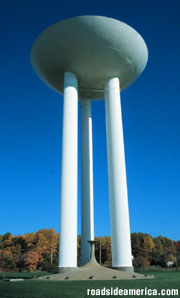
There's a unique water tower on the park-like property of the old Bell Labs, resembling an H.G. Wells Martian tripod more than anything. The white, three-legged saucer looms over the entrance drive to the former research and development facility, once a scary mirrored sarcophagus of deep think and E-novation (built and owned for 35 years by AT&T, then Lucent, and then sold with company remnants to Alcatel, then reborn as tech corporate campus BellWorks).
The saucer water tower is actually modeled after the design of an early transistor, invented by three Bell Labs researchers in 1947. John Bardeen, Walter Brattain, and William Shockley later won the Nobel Prize in physics. Their first experimental transistor, a misshapen clump of ceramic and wire, would make for a poor water tower. Holmdel's appears based on later production versions -- the kind that replaced bulky glass tubes and changed the world.
The transistor breakthrough happened at another Bell Labs facility further north (Murray Hill in Berkeley Heights), but the 60-ft tall tower tribute was erected here in 1961, when they broke ground for the Eero Saarinen-designed building (Saarinen was a renowned architect who also designed the St. Louis Gateway Arch). It was the Bell System's Bell Labs at the time, then AT&T's Bell Laboratories, then became simply Bell Labs in 1996 with the spin-off of Lucent.*
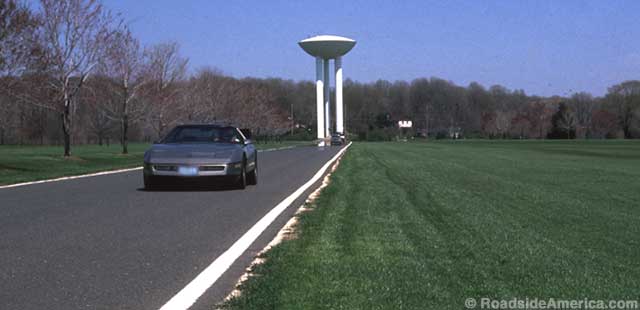
Bell Labs was sold, the building sat vacant for years, then was refurbished and reopened as a mixed-use business/retail/residential venture. The water tower survived. Visitors today can easily enter the building, which contains explanatory signs, tech businesses, coffee shops, the "Big Bang" Cafe, and the town's public library. The campus achieved a pop culture milestone in cable series "Severance" as a sinister bifurcation of work-life.
More Fun Facts About the Big Mirrored Coffin Building!
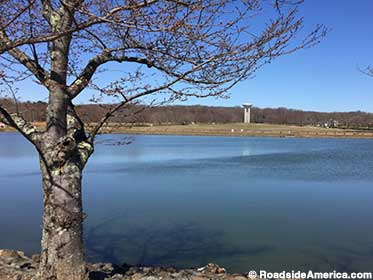
View from the cooling pond.
1) The interlocking wall sections in labs were designed to be "blast resistant." If one researcher's experiment to compress space-time exploded, scientists in adjacent labs could continue working....
2) According to a story told about the early days at HO (facility letter code for "Holmdel"), after architect Eero Saarinen died, his widow planned a visit to the building he'd designed. Facility operations staff quickly scrambled to remove gaudy hanging plant gondolas from the central atrium, a post-Saarinen embellishment that would have made him spin in his grave.
3) The building was conceived to be an impenetrable mirror by day, and a dazzling hive of light at night. But during the 1970s Energy Crisis, Bell Labs permanently de-bulbed five of every six light panels -- creating a murky after-hours warren for research-aholics.
4) In the 1970-80s heyday of employee clubs and lunchtime activities, an elaborate model railroad layout built by hobbyists filled several hundred square feet of a storage sub-basement.
More Sights
The Bell Works property also preserved: an abstract sculpture mimicking the configuration of the first radio astronomy array, used on this very spot in the 1930s by Karl "Father of Radio Astronomy" Jansky.
About 2 miles north of the water tower, on Holmdel-Keyport Road, there is another old Bell Labs building. There used to be two historical markers along the road (missing when we checked in 2007): one noting that the background radiation from the Big Bang was first detected by a horn antenna in 1965 here on Crawford Hill; and the other that telemetry from the Telstar satellite were first picked up here. The Big Bang Horn Antenna is still on Crawford Hill, though likely behind gates. In late 2022, the location, highest in Monmouth County and with a view all the way to Manhattan, was being eyed for residential development.
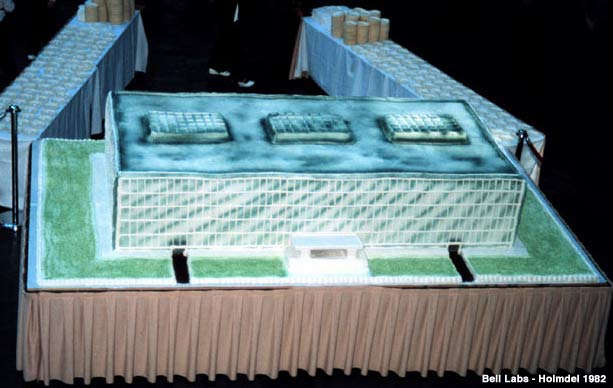
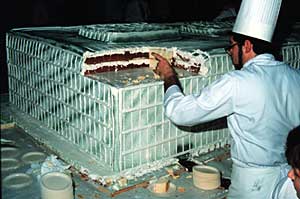
Performance Bonus: Life at the Holmdel Labs: at the 1982 celebration of the building's 20th anniversary, a giant cake replicated the six-story mirrored exterior. Employees attempted to get served the slices that were their offices. Here's the whole cake.
* Full confession: one author of Roadside America worked in this building off and on for decades, hence our accumulation of on-site arcana, colorful rumors, and long suppressed truths.

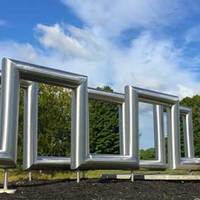 Father of Radio Astronomy - Jansky Monument
 Vietnam Era Museum & Educational Center
 United States War Dog Memorial