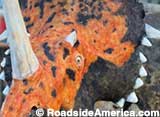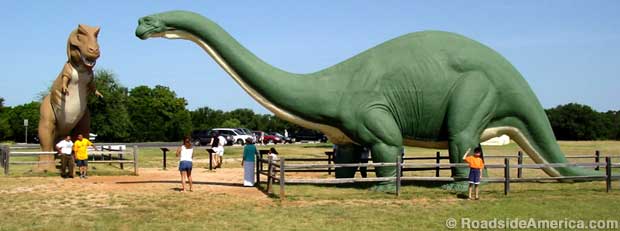
Suddenly it's 1964! Retro dinosaurs greet visitors to Dinosaur Valley State Park.
Dinosaur Valley State Park

Glen Rose, Texas
Just down the road from the Creation Evidence Museum, which wants to prove that humans and dinosaurs once walked together, humans and dinosaurs really do coexist -- at the entrance to Dinosaur Valley State Park.
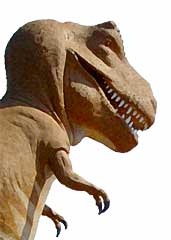
The two life-size fiberglass dinosaurs are a dagger-toothed Tyrannosaurus rex -- 19 feet tall -- and a sleepy-looking Brontosaurus. The 70-foot-long Brontosaurus is angled to provide maximum shade from the blistering Texas sun, and during our stop most of the Park visitors were huddled within the dinosaur's large, cool shadow, their backs unappreciatively turned to its impressive bulk.
Both statues -- designed by Louis Paul Jonas, a once-famous taxidermist and wildlife sculptor -- are from Sinclair Dinoland, which showcased nine different dinosaurs at the 1964-65 New York World's Fair (The Sinclair Oil Co. used dinosaurs as its brand mascots, even though oil doesn't come from dead dinosaurs). When the Fair ended, the Dinoland statues were loaded onto flatbeds and trucked cross-country as a traveling exhibit (often parked outside of shopping centers), before they were eventually scattered to various new homes. T. rex and Brontosaurus -- the most popular denizens of Dinoland -- found their way to Dinosaur Valley, and were officially dedicated at the Park on October 2, 1970.
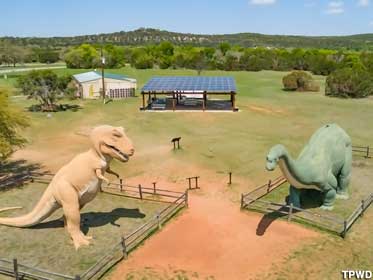
Drone view shows where tourists have worn away the grass, posing for snapshots.
The T. rex and Brontosaurus were also the only two Dinoland dinosaurs that had mechanized jaws -- a forerunner of today's dino park roaring dinosaurs -- but their internal gears and motors were removed when the Fair closed.
Dinosaur Valley State Park is known for its hundreds of visible fossilized dinosaur tracks in the bed of the Paluxy River, left by Acrocanthosaurus and a Sauroposeidon dinosaurs, similar to the T. rex and Brontosaurus (which is why those Dinoland refugees were sent here). Asa Vermeulen, the park's assistant superintendent, recalled one group of visitors who were shocked that dinosaurs had actually made the footprints. "You mean that dinosaurs are real? They aren't just in movies?'" And then there were the visitors who saw the tracks and asked, "When are you gonna feed the dinosaurs?" because they didn't want to miss it. "I laughed it off as a joke," said Asa. "But they were not joking."
The Creation Evidence Museum was built nearby because it claims that "giant man tracks" have been found along with the dinosaur footprints, thereby proving the existence of biblical giants (and disproving evolution). Asa said that the tracks are really the eroded footprints of the Acrocanthosaurus. And some of the earliest-discovered man-tracks were forgeries carved (and sold) by enterprising locals.
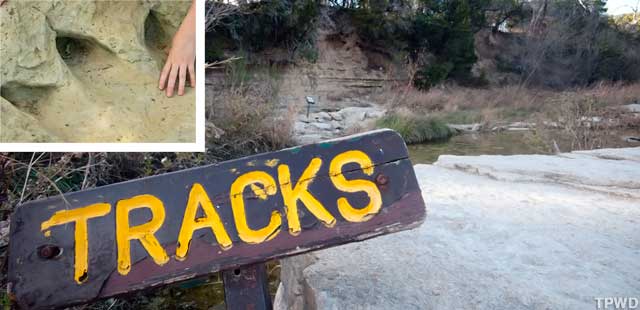
Helpful signs direct visitors to the fossil dino-footprints.
A few years after the T. rex and Brontosaurus arrived, paleontologists announced that there was no such a thing as a Brontosaurus. They said that it was a mistake: a Camarasaurus skull stuck on an Apatosaurus body. So in 1987 the Texas Parks and Wildlife Department made a new head for the Brontosaurus, redesigned to conform to this revisionist thinking. The creature was labeled a Paluxysaurus. Texas politicians proclaimed Paluxysaurus to be the state's official dinosaur.
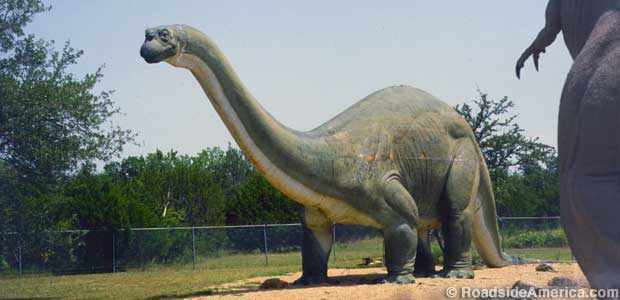
Brontosaurus the way it was meant to be: with a World's Fair head.
"But it just didn't look right," said Asa. Photos from the time show the massive Brontosaurus body topped with the supposedly accurate head, which looked absurdly tiny. "There was such an uproar about it," said Asa.
So in 1995 Texas Parks and Wildlife changed it back to the original head.
"We understand now," said Asa, "that these dinosaurs have a cult following for what they were, not for what we think they should be." The spurned head, he said, was retired to Texas Parks headquarters in Austin.
But that wasn't the end of the story. In 2012 a new generation of scientists concluded that there was no such thing as a Paluxysaurus, and in 2015 they took the final step and announced that Brontosaurus did, in fact, exist. The prehistoric world of the 1964-65 New York World's Fair turned out to be right after all!

 Dinosaur World
 Creation Evidence Museum
 Stone Hut Fossil Shop