National Museum of Health and Medicine

Silver Spring, Maryland
The teenagers get it. Squeals of "EEYOUUU!" and "YUCK" echo among the tall glass displays as yet another generation discovers a giant tumor or the stomach-shaped hairball. Just a typical day at the National Museum of Health and Medicine, America's oldest taxpayer-funded Cabinet of Curiosities.
For decades the museum was northwest of Washington DC, deep in government property, hidden behind the Walter Reed Army Medical Center -- the way one might hide a hideously deformed relative. In 2011 it moved to a new facility in Silver Spring, MD. It's a national treasure where each plastinated organ, skeleton and bone fragment has a tale to tell.
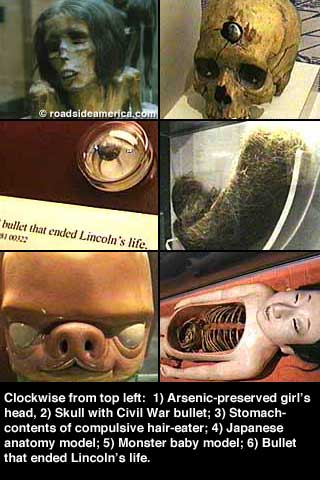
We often think of the Museum as an imperfectly preserved pathological specimen. Parts are great, showing off items that have been in the collection since the Civil War. Where else can you see pieces of Abraham Lincoln's skull? But we'd also find half of the floor space eaten away by modern health awareness displays about AIDs, or the development of the microscope. Much of the old collection sits in storage, a small percentage occasionally seen by the public as exhibits rotate.
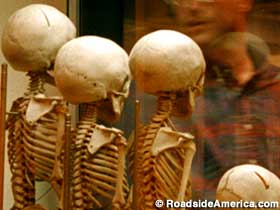
Things had changed a bit since our last visit. [The following describes what we saw before the facility moved in 2011] The chorus line of baby skeletons is still visible from across the lobby, part of a gallery on fetal development and birth defects (though the specimens are less graphic than what you find at the Mutter Museum). But gone is the interactive computer terminal that let you play Lincoln's deathbed doctor ("Congratulations! You've scored an 84 out of a possible 100. The nation applauds your effort as a doctor and as a responsible member of society. Unfortunately, the President is dead."). A museum employee told us that it frequently broke down.
The Presidential display includes the bullet that killed Lincoln, and bits and pieces of the assassinated President, and the "life mask" plaster molds of his head and hands (there's another set on display in the basement of Ford's Theater).
There are medical education oddities, such as the hopelessly inaccurate 18th century anatomical models from Japan. An area on Civil War medicine photographically chronicles early attempts at plastic surgery on soldiers who had lost half their faces to bullet and shrapnel wounds.
A wax head of a 19th century sailor with a barnacle-encrusted nose demands your attention. "Sailor addicted to excessive consumption of alcohol and tobacco," reads the sign. "Rhynophyma," colloquially known as "brandy nose." It's really disgusting.
The mummified head of a Kentucky girl -- an image that will chase you into fitful dreams -- is out of "storage" and back on display in an exhibit titled "Research Matters: Environmental and Toxicological Effects of Arsenic."
The two most popular exhibits are the hairball and the leg bone. The hairball is a crowd pleaser -- a 12-year old girl compulsively ate her own hair; fortunately, someone had presence of mind to preserve the gastronomic mess. The leg bone is that of Maj. Gen. Daniel E. Sickles, displayed along with the 12-pound cannonball similar to the one that shattered it at Gettysburg in 1863. "For many years he visited the museum on the anniversary of its amputation."
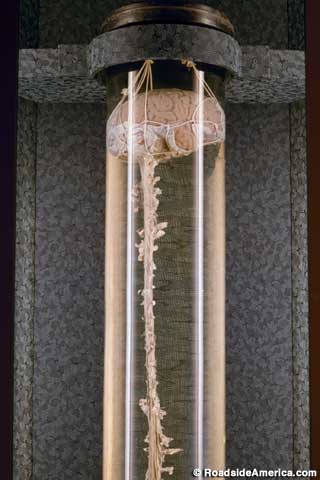
It's almost impossible for a place like this, with skimpy federal funding and a terminal desire for social relevancy, to stay in touch with the public. But connections are made. A complete brain and spine, suspended in liquid in an eerily lit glass cylinder, is barely explained. A way to give physiological context to the human mind? A homage to the human trophies in the Predator films? No one cares -- it just looks scary and cool.
The museum is popular with school groups, as well as sailors and doctors dragging along their horrified families. But like all medical museums, it will never be a must-see for vacationers.
In Storage...
Items in storage that we've seen on previous visits (or this time maybe we didn't look hard enough.):
- A piece of John Wilkes Booth's spine
- the brain and skeleton of President Garfield's assassin
- the gangrenous human foot
- microscope slides of Ulysses S. Grant's tumor
- a mummified "human dicephaly" (Siamese twin baby)
- a hat struck by lightning
- shorts found in a shark's stomach
- the colon of a soldier who had diarrhea for four months


 National Park Seminary: Pagoda, Castle, Windmill
 Mormon Temple - Fairy Tale Rockets
 Big Hand Releasing Birds