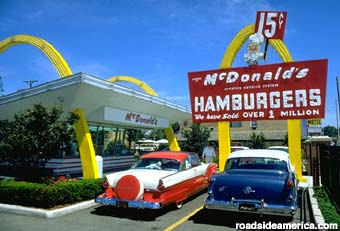
McDonald's Store No. 1 (Gone)

Des Plaines, Illinois
We revere sacred spots. On the American highway, these places aren't where saints were martyred or battles waged, but where our great fast food chains began -- those crowning symbols of entrepreneurship and brand consistency.
Unfortunately, the worship began only in the last few decades. Our cultural consciousness didn't elevate soon enough to stop demolition of most original burger huts and milkshake palaces. And as elevated sugar and fat intake has fueled our engines of diabetic obesity, the Fast Food industry is under assault. Salads and low-fat drinks may transform the chains, but that's no reason to forget their origins....
For many -- the world's first Hardee's, Burger King, Carl's Jr, White Castle, Wendy's -- all that's left are old photos. But the Col. Sanders Cafe was restored to its 1940s KFC-birthplace splendor in Corbin, Kentucky; the first Pizza Hut was moved and preserved for study at Wichita State University, Kansas; and the first In-N-Out Burger was rebuilt from scratch in Baldwin Park, California.
So what about the Queen Mother of Value Meals?
McDonald's Corporation held onto the patch of property west of Chicago where franchise Store #1 stood; Ray Kroc first opened for business there on April 15, 1955, and he considered it to be his favorite store. But like all McDonald's it was remodeled repeatedly over the years. In 1984, the year Kroc died, Store #1 was demolished and then completely rebuilt in 1985 to look just as it did in 1955 (as a museum, not serving food). A modern McDonald's opened for business right across the street.
With golden arches soaring over a glass/metal/red-and-white tiled exterior, the building follows the original blueprints, with some modifications as a museum. The entrance sign is a rare single-arch original, with early cartoon mascot "Speedee" and the first boast: "We have sold over 1 million."
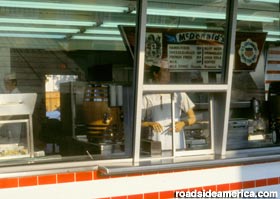
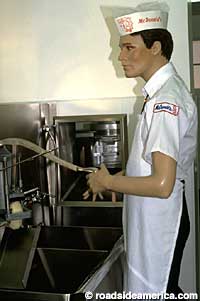
The replica restaurant/museum could be viewed only through the windows, because repeated flooding from the nearby river forced the building to close its interior to the public in 2008. The ground floor exhibits original fry vats, milkshake "Multi-mixers," soda barrels and grills, attended to by a crew of male mannequins in 1950s uniforms. You can peek through the order windows in front (there was no sit-down restaurant section in that era). Nothing is operating or moving, so the effect is eerie, like a cheap sci-fi show where time has frozen.
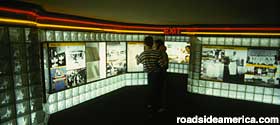
Down in the basement (now off-limits) was a low-ceilinged space with back-lit glass brick walls, showcasing a collection of vintage ads, photos, and a video about McDonald's history. There wasn't room for much else. End of tour.
Over at the modern McD's, you can view a half dozen glass-enclosed exhibits arrayed around the tables, but patrons shoot dirty glances when you lean over them to examine the artifacts. There are red and white tiles from the original restaurant, and string ties worn by employees from the 1950s to the early '70s.
In comparison with other consumer product histories writ ludicrously large, such as Coca Cola, or even Zippo Lighter, McD's salute to self-importance always seemed way too laid back. As a global icon, McDonald's owes it to civilization to build a magnificent Golden Arches City or Speedee's World of Food History -- and do it now, while portions and customers are still super-sized.