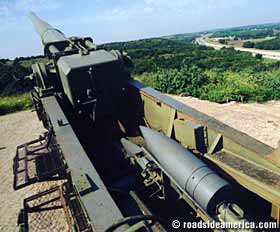
Shell ready.

Atomic Cannon

Field review by the editors.

Junction City, Kansas

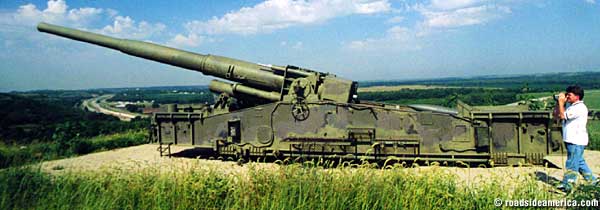
The atomic cannon was a huge piece of ordnance built by the United States in the mid-1950s to hurl nuclear shells far enough that they wouldn't kill the people who fired them. While far more sensible WWIII technology than, say, the atomic hand grenade, the atomic cannon did have its detractors and tactical limitations.

The first atomic cannon went into service in 1952, and was deactivated in 1963. A single 280mm shell was fired seven miles at the Nevada Test site on May 25, 1953 as part of the Grable Shot series. The shell detonated 500 feet in the air and yielded a 15 kiloton explosion (there's an amazing government film of the cannon firing and the mushroom cloud).

Atomic Cannon sign.

Twenty Atomic Cannon were manufactured; at least 8 appear to have survived the Cold War and are on public display today. The largest atomic cannon sits in a public park in Junction City, Kansas, on loan (permanent) from the Smithsonian. You can find the others at:

  • Yuma Proving Ground, Yuma, Arizona
  • Rock Island Arsenal, Memorial Field, Rock Island, Illinois
  • Army Ordnance Museum, Aberdeen, Maryland (still has the two large "prime movers" attached)
  • Atomic Museum, Albuquerque, New Mexico
  • Fort Sill Museum, Oklahoma
  • Virginia War Memorial Museum, Newport News, Virginia
  • Watervliet Arsenal, Watervliet, NY -- where they were all manufactured.

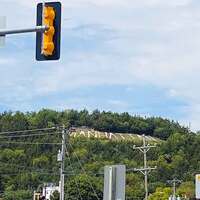
Junction City's is most grandly displayed, high atop a bluff in "Freedom Park," advertised with red-white-& blue billboards along the interstate. A switchback trail leads up to the summit, past rusting howitzers and small pieces of artillery.

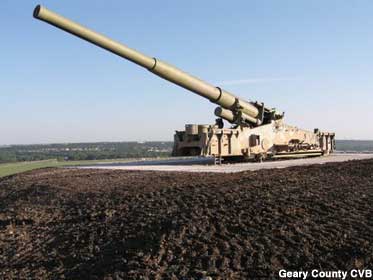
Atomic Cannon.

The Atomic Cannon, an M65-280mm, is 42 feet long and weighs 42,500 lbs. It can throw a shell 20 miles, which would place ground zero southwest and just shy of Abilene (home of the Eisenhower Museum and the Hall of Generals).

The climb is invigorating, and the A-cannon, while impressive, could be any other plugged-up piece of old military hardware. No special markings, flash protection screens, radiation symbols. Guess if something went wrong, there's really no point. A display shell sits in the breach, ready to loft towards Ike's hometown.

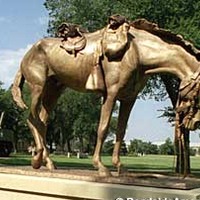
After paying your respects to the Atomic Cannon, visit nearby tributes to weapons actually used in combat. Across the interstate, about two miles, is Fort Riley: home to the US Cavalry Museum, Big Red One Museum, a monument to sick and dying army horses, and a long-forgotten Geographical Center of USA monument.

Atomic Cannon

Address:
Junction City, KS [Show Map]
Directions:
NE of Junction City off I-70, on the right. In "Freedom Park," at exit 301.
Add to My Sights | Show My Sights

Nearby Offbeat Places

More Quirky Attractions in Kansas

Stories, reports and tips on tourist attractions and odd sights in Kansas.

Explore Thousands of Unique Roadside Landmarks!

Strange and amusing destinations in the US and Canada are our specialty. Start here.
Use RoadsideAmerica.com's Attraction Maps to plan your next road trip.

My Sights

Map and Plan Your Own Roadside Adventure

Try My Sights

Kansas Latest Tips and Stories

Latest Visitor Tips

Sight of the Week

Sight of the Week

SPAM Museum, Austin, MN [Nov 17-23, 2008]

SotW Archive

USA and Canada Tips and Stories

Latest Visitor Tips

Take Our Poll

sightings. Arrives without warning. Leaves no burn marks. A free newsletter from RoadsideAmerica.com. Subscribe now!
RoadsideAmerica.com Hotel & Motel Finder

Special online rates for hotels & motels.

Book Online Now