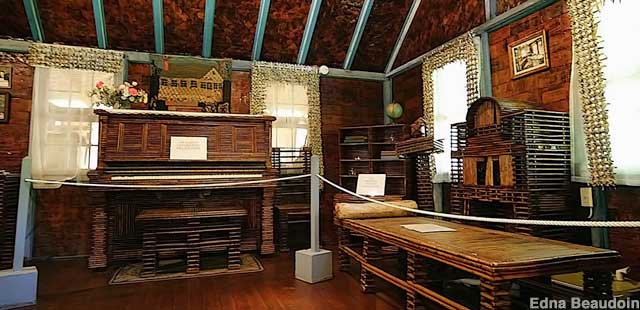
Inside the Paper House. Everything brown except the floor is made of newspaper.
The Paper House

Rockport, Massachusetts
The idea of a house made of paper sounds insane, but it intrigued a mechanical engineer named Elis Fritiof Stenman (1873-1942).
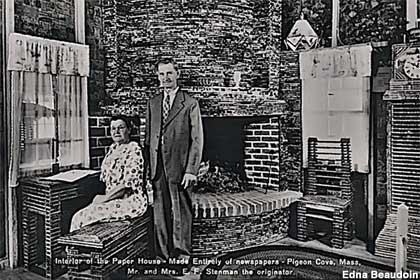
Old postcard of Esther and Elis Stenman in the Paper House.
So in 1924, he built one.
The house, on the rocky coast of Cape Ann outside of Boston, was the summer cottage of Elis and his wife Esther. The roof, floor, porch, and framework were made of traditional materials, but everything else was paper. Specifically, newspaper. Elis read three of them a day, so he had plenty of raw material -- and when neighbors and friends found out about his project, they donated their day-old papers to his supply. Elis's motives were murky -- no one is really sure why he did this -- but his devotion to the project was clear. By the time the House was completed, Elis had glued, folded, and varnished an estimated 100,000 sheets of newsprint.
For insulation, Elis filled the gaps between the wooden frame with newspaper, tightly rolled into rods on a device of his own invention. The ceiling and walls, both inside and out, were made of sheet newspaper panels, 215 layers thick, pressed and bound with a glue that Elis made of flour, water, and apple peels. The outside of the panels was given a decorative layer of newspaper-wallpaper folded into squares and triangles and held in place with upholstery tacks. Elis liked the idea that you could "read" the Paper House, so the papers in the outer layer were chosen for their bold headlines and graphics. Visitors to the Stenman house would be handed a sheet of newspaper, and told to start folding.
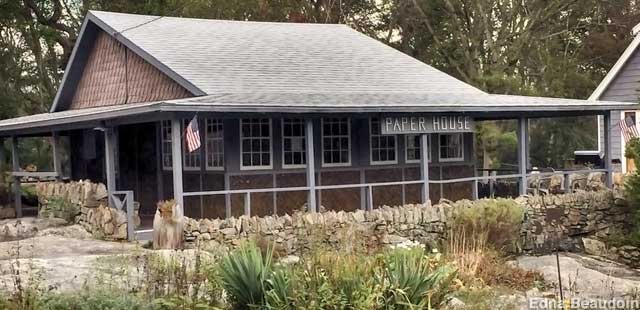
Without the sign, you'd never realize why this house is so special.
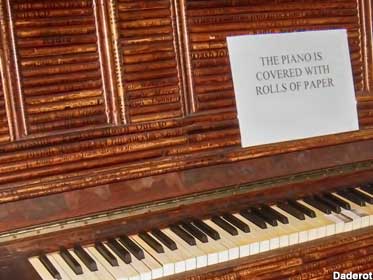
Helpful reminder of what you probably already know.
Once every paper surface had been sealed beneath a waterproof coat of marine varnish -- carefully, to avoid destroying the newsprint -- Elis and Esther moved in. But Elis was just getting started. He decided that all of the furniture in the house should be newspaper as well, so he began adding newspaper chairs, tables, desks, stools, bookshelves, a floor lamp, a cot, a grandfather clock. Esther contributed window drapery made of woven strips cut from magazine covers.
The furniture, made of Elis's newspaper rods, was often topical, and designed so that the sections of visible newspaper reflected the theme. A writing desk was made from accounts of Charles Lindbergh's transatlantic flight in 1927. A radio cabinet was plastered with news from Herbert Hoover's presidential campaign in 1928. The piano (Esther played the piano) featured newspaper reports of Admiral Byrd's North and South Pole expeditions. Elis once told a reporter that he'd received thousands of offers to buy his newspaper furniture, but that he would never sell it.
You'd think that someone nutty enough to build a house out of paper would've designed a structure equally outlandish -- like the Corn Palace. But Elis was a practical engineer at heart, and his two-room Paper House was mostly devoid of creative mania. The modest scale of the house can be deceptive; tourists sometimes can't believe that people lived in it. It helps to know that a kitchen stove and sink once stood where the newspaper-manteled fireplace is now, and that Elis and Esther slept in a loft bed (since removed) up near the roof. Their bathroom was a non-paper outhouse in the yard.
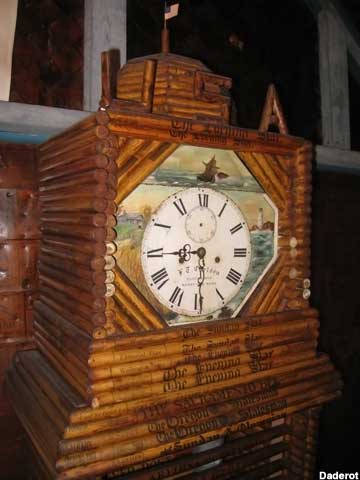
The clock case is made of newspapers from all then-48 states.
By 1930 so many people were visiting the Paper House that the Stenman's moved next door, into a normal house, and opened the Paper House full-time as an attraction. It was then, and is now, operated on the honor system. Visitors are asked to leave a cash donation in the mailbox, and to close the door and turn out the lights when they leave.
Edna Beaudoin, grand-niece of Elis and Esther, inherited the Paper House and became its caretaker in 1995. "Esther had reached out to various people and nobody was interested in running a Paper House," she told us. Edna viewed the House as a family heirloom and maintains it out of a sense of responsibility, although she admits that Elis's vision eludes her. "He must have been the neighborhood weird guy," she said.
Indoors, visitors still enjoy reading the ads, recipes, and headlines from long-gone newspapers, although the protective layer of varnish -- like the one formerly coating the Sistine Chapel -- has turned dark with age. Out on the porch, the exterior walls have begun to peel away in spots. "You have to keep it varnished in the fall," said Edna, "and it's a tedious job because it's so brittle. Even if you just gently touch it with a paintbrush you get all these little pieces of paper that break off." Discouraging, perhaps, although Edna knows that there are a couple of hundred layers of newsprint underneath.
A house made of paper should have blown down or burned up years ago. Yet the Paper House has survived, despite decades of nor'easters and blizzards, as well as countless nights toasted by Elis and Esther's flammable fireplace. "When a hurricane comes along I ask, 'Is the Paper House still there?'" said Edna. "'Yep. Still there.'" The thought seemed to catch her by surprise. "Holy smoke, the house is going to be a hundred years old!" she said. "It's really kind of mind-boggling when you think of it."

 Dogtown Ghost Town and Babson Boulders
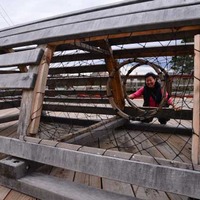 Big Lobster Trap
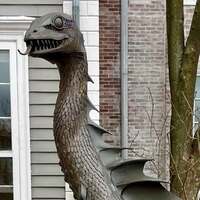 Cape Ann Sea Serpent Statue