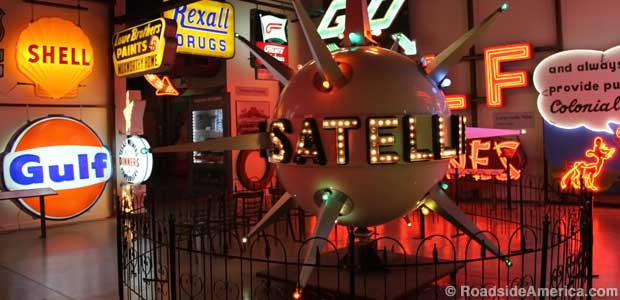
The "Sputnik sign" spins endlessly in a constellation of other vintage highway showstoppers.
American Sign Museum
Cincinnati, Ohio
"When people come here they say, 'You know, I never really thought about signs,'" said Tod Swormstedt, founder of the American Sign Museum. Tod has been trying to get people to think about signs for most of his life. Since 1906 his family has owned Sign of the Times, a trade journal for the sign manufacturing industry. Tod was its editor and publisher -- and a self-taught sign expert -- when he began collecting signs in 1999. He opened the museum in a Cincinnati artists' co-op in 2005.
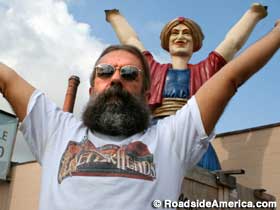
Tod Swormstedt at the old Sign Museum, when his Carpet Genie had no hands.
But Tod's signs were too big, and his collection was growing too fast. In 2012 he moved the museum to its current address: a former parachute factory four times the size of the former museum. With 28-foot-high ceilings it has room for all but the tallest of Tod's signs. He guesses that his electric bill is around $45,000 a year. He buys his light bulbs -- some very expensive -- by the crate. He has a working neon shop as part of the attraction, which comes in very handy for repairs.
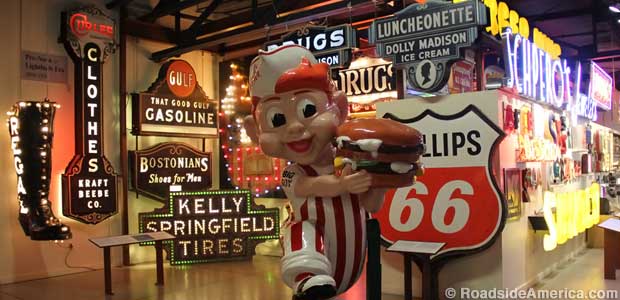
1960s Big Boy. On the left are early signs from before the age of neon.
Signs are a huge part of the Roadside universe, and welcome friends to people who drive. Yet a walk through the American Sign Museum -- or, really, any sign museum, if there were any other sign museums, which Tod says there aren't (although he appreciates specialized sign collections such as the Neon Boneyard) -- is also a little sad. These signs, often candy-colored, bedazzling spectaculars, no longer serve their intended purpose. They have vanished from their natural habitat, and must battle for eyeballs here with hundreds of competitor signs. Only the most mesmerizing are memorable.
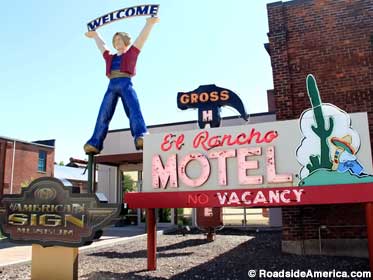
Entrance to the new museum.
A smiling fiberglass Big Boy, for example, holds aloft a dripping cheeseburger; Tod said that the slingshot in his back pocket dates him to the 1960s, before the weapon was removed. There are Burma Shave signs; neon signs from Holiday Inn, Howard Johnson's, and a winking Speedee McDonald's; even entire side-of-a-barn signs for Mail Pouch Tobacco and Rock City.
"American icons," said Tod, matter-of-factly. "If you don't have them, you're not much of a sign museum."
"We start about 1900 and go to the late 1960s," Tod said, walking past a 1936 sign: Blood Makes Good Paint. "We're the only museum that covers the whole range of signs." Tod ticked off a list of categories: wood, metal, gold leaf, porcelain enamel, gas, light bulb, neon, plastic.... Visiting the museum is like a walk through a timeline of visual screaming, with every few feet leading to more spectacular signs, grabbing the attention of people desensitized by the signs of only a few years before.
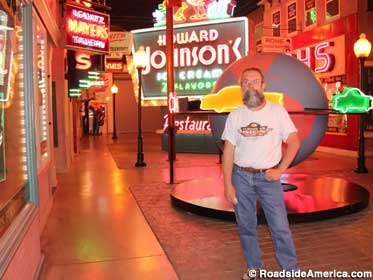
It's always night in "Signtown," which Tod created as a kind of indoor sign heaven.
The walk ends at "Signs on Main Street," a fake indoor downtown and a neon-lover's dreamland, where it's always night and none of the sign tubes or bulbs are broken. "I designed a whole street of storefronts backwards," said Tod, obviously proud, who compared it to Main Street USA in Disneyland, but with full-size buildings meant to highlight the signs instead of the other way around. All of the storefront windows are display cases for smaller signs, or for some facet of sign design or specialization. Dozens of signs, built to be seen from far away, are only inches from your face. "We call it 'Signville' or 'Signtown,' said Tod. "Instead of trees or fountains in our town square, we have more signs."
Surrounded by a spectrum of glowing, spinning, blinking showstoppers, Tod said that museum visitors will ask, "Why don't we have these kinds of signs any more?" Tod knows the reasons: corporate standardization, misguided beautification projects, restrictive sign codes. "Unless you ran a business and tried to put up a sign, you'd have no concept of that."
Tod walked us over to a slowly spinning orb studded with long neon spikes. He called it a Sputnik sign; it advertised a strip mall in Anaheim named Satellite Shopping. "The guy ended up building it himself," Tod said. "He took the idea around to a couple of sign companies, but they all said he was crazy." Funky signs like Sputnik wow the public, but Tod said that his favorite signs are the older, pre-neon creations of the early 20th century. "They're very, very creative, you know." We didn't, but we know that Tod knows more than us about signs. A lot more.
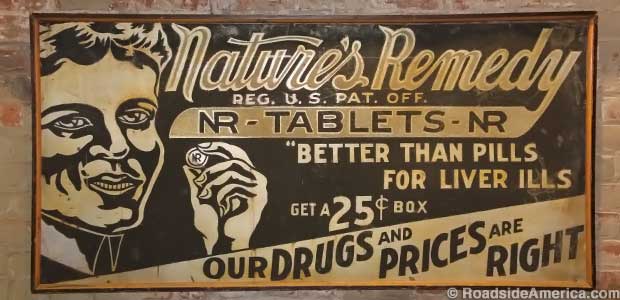
Some early sign painters could paint people better than others.
"We get calls all the time: 'You gotta save this sign!'," said Tod. "But they don't understand the logistics or the money." Some signs are too big to transport. Some are so old that they collapse if you try to move them too far (The museum has a half-destroyed Kona Lanes bowling alley sign as an example). Frankly, Tod already has more signs than he can handle at the American Sign Museum. "We'd much rather see the signs stay where they are, or go to a local museum or park," said Tod. "We're third on our own list for homeless signs."

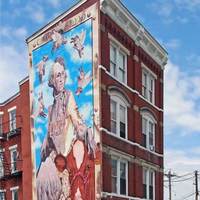 Mural: George Washington in Drag
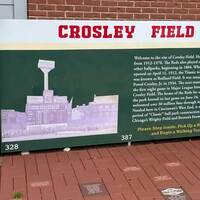 Crosley Field Footprint
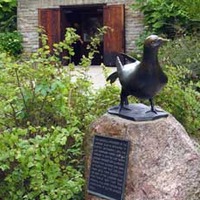 Martha - Passenger Pigeon Memorial Hut