World's First Nuclear Power Plant: Tour
Arco, Idaho
Looking out over the flat expanse south of Arco, its understandable why it has been used for nuclear reactor experimentation and development. Any slip-ups would render uninhabitable a plain already devoid of trees or towns. It's pretty empty here still, with most of the 900-square mile Idaho National Engineering Laboratory closed to the public.
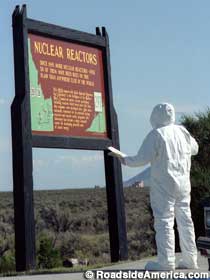
A historical marker at a scenic pull-off boasts that "Since 1949, more nuclear reactors -- over 50 of them -- have been built on this plain than anywhere else in the world."
The world's first peacetime use of nuclear power occurred when the U.S. Government switched on Experimental Breeder Reactor #1 (EBR-1) near Arco, Idaho, on December 20, 1951. The town of Arco* became the first city in the world to be lit by atomic power from a reactor built near EBR-1, the BORAX III, on July 17, 1955. It was only temporary, but the way was paved for commercial use of nuclear power. The Arco reactor later suffered a partial meltdown -- another World's First. There's no highway sign bragging about that.
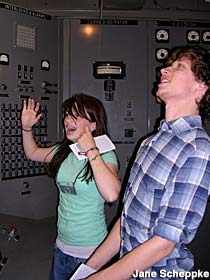
At EBR-1, tours are self-guided. See the first light bulbs lit by atomic power and "the hot cell," sealed from the rest of the world since 1974, and protected from you by multiple layers of oil-separated glass over three feet thick. They made plutonium-239 in this blocky building. You can take pictures, try your skill at operating a robotic arm, and act out your own Chernobyl in the main control room.
Outside, picnic tables are thoughtfully provided under a pair of house-sized atomic jet engines, another experiment. Nowadays the site likes to promote its peacetime mission and environmental charter.
*A yearly highlight in Arco is its annual "Atomic Days" celebration, usually held the second or third weekend in July.

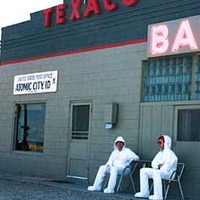 Atomic City
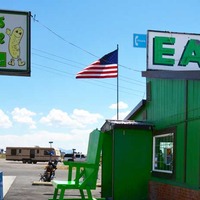 Home of the Atomic Burger
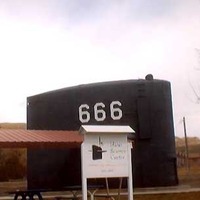 Devil Boat - Submarine In The Desert