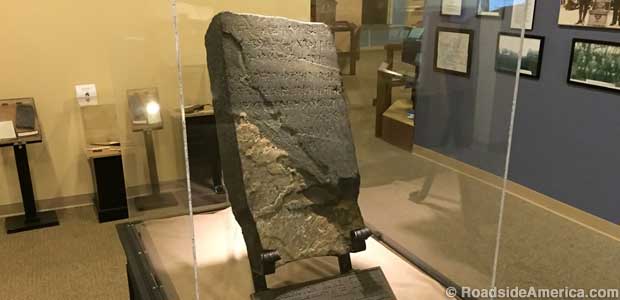
Safe in its namesake museum, the Kensington Runestone upends U.S. history in a quiet, Scandinavian way.
Runestone Museum

Alexandria, Minnesota
America loves Vikings, and maybe no place in America loves them more than the Scandinavian-settled city of Alexandria, which has clutched the redbeards to its civic bosom for over 100 years. At the city's heart is a 202-pound rock slab inscribed with Norse runes -- the Kensington Runestone -- which sits just inside the entrance to the Runestone Museum. The bronze plaque beneath it, dated 1928, says that it was, "Placed in Douglas County by the Vikings." This has led to no end of continuing confusion.
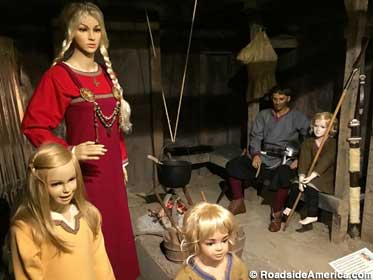
Stay-at-home Viking dad and his flaxen-haired family in the Viking house exhibit.
The Runestone, whose inscription is dated 1362, was found in 1898 several miles outside of Alexandria by a Swedish immigrant farmer named Olof Ohman. Was it real? Was it fake? Was Ohman trying to pull another Cardiff Giant? (A narrated museum video states that, "Nobody could believe he would do such a thing.")
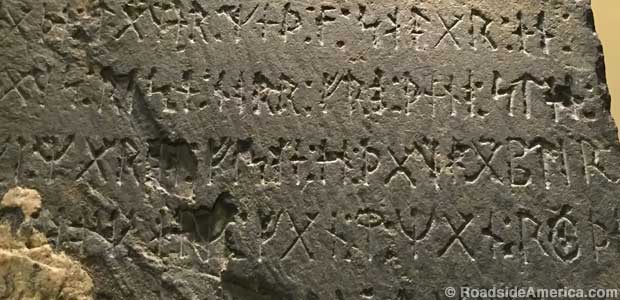
The runes that could eventually ruin Columbus Day.
Scholars dismissed the Runestone as impossible, and Ohman as either a fraud or a fool. Disheartened, he used the slab as a doorstep, then sold it to a guy in Wisconsin for ten bucks.
With the passage of time, experts have become more accepting of the Runestone (although it still has skeptical foes). According to museum director Jim Bergquist, the Runestone was even displayed for a time in the Smithsonian. In the early 1950s it was given to Alexandria, which built a giant replica on the outskirts of town, and then built the Runestone Museum specifically to display the original.
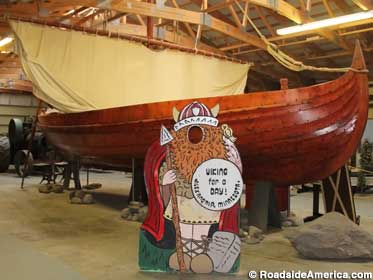
Viking ship and photo-op in the museum annex.
The museum has a wide range of exhibits beyond its namesake slab. There are displays on the Minnesota butter and lumber industries, locally-discovered Mammoth bones, and transportation in the snow. There are many large mounted dead fish. Behind the museum stands "Fort Alexandria," a village of pioneer buildings including a stagecoach stop and a Norwegian immigrant log house.
Second to the Runestone in museum notoriety is Spotty, a little fox terrier that was stuffed in the late 1950s. Spotty belonged to "Grandma" Ella Pearson and lies on a rug "watching for grandma's return," according to his display. "Kids either love him or are creeped out by him," said Jim.
Spotty is a two-thumbs-up attraction, but most of the museum's visitors still come because of the Runestone. Exhibits surrounding the slab cite laser scans, high-tech studies of "mica degradation," and advances in language scholarship to show that "it would have been impossible" for even a genius to fake the Runestone in 1898. Ancient-looking axeheads and other relics, found nearby, boost its credibility. A map traces the possible route taken by the Runestone's carvers from Scandinavia to Kensington. All but 40 to 50 miles, said Jim Bergquist, could have been traveled by water.
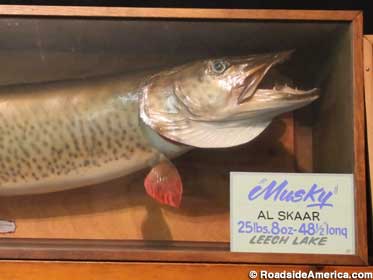
No museum in Minnesota is complete without at least one big fish.
The map is illustrated with a Viking longship, and that's the other confusing thing about the Kensington Runestone. Ask anyone at the museum, and they will honestly explain that the Viking Age ended 300 years before the Kensington Runestone was (supposedly) carved. There were no Vikings in 1362, not even far-flung Vikings in Minnesota. Yet the museum has a 40-foot-long replica Viking boat in its annex, a big oil painting of a Viking family, and a wax dummy diorama of a Viking home. T-shirts for sale in the gift shop read (in runes), "If you can read this, you're a Viking." Outside, under the museum's stewardship, stands Big Ole, a 28-foot-tall statue of a Viking. The city loves it.
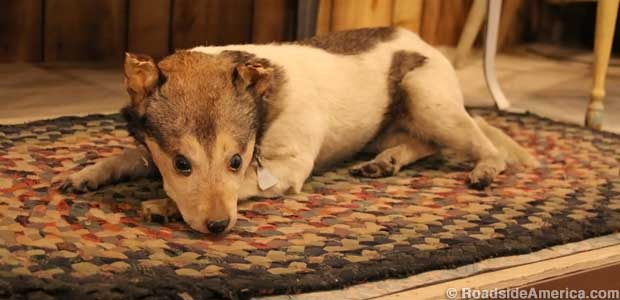
Spotty the dog, stuffed in the late 1950s -- a bonus at the Runestone Museum.
Jim said that local Scandinavian pride and Viking fandom makes things "a little bit sloppy" when it comes to crediting the creators of the Runestone. He knows that there's a big difference between an axe-whacking Viking and a late medieval Scandinavian explorer, but, frankly, most people just don't care. "When we upgraded our Viking Home exhibit," said Jim, "we asked, 'Should we try to come up with what kind of clothing they wore in 1362? Is anybody interested in that sort of thing?'" Jim knew the answer. "Not too many people."
"Then," Jim continued, "we asked, 'How many people are interested in Vikings?' And we answered, 'Everybody!' So we decided to stay with that."

 Spotty the Stuffed Dog
 Big Ole: America's Biggest Viking
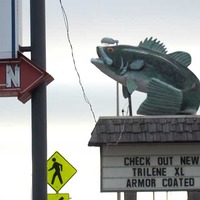 Big Fish Atop a Sign