Ludlow Massacre - Birthplace of Public Relations
Ludlow, Colorado
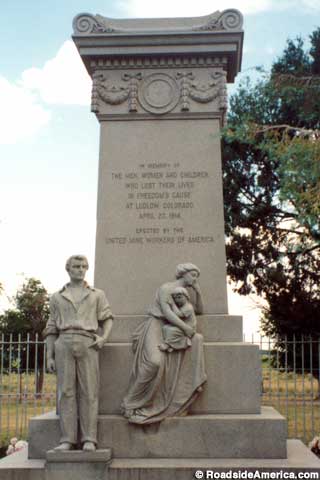
On April 20, 1914, billionaire John Rockefeller ordered the Colorado militia (through his pal, the Colorado governor) to open fire on a camp of striking mine workers and their families. It ended with bodies of dead mothers and babies strewn about a field of burning tents, and has since been named the "Ludlow Massacre." The United Mine Worker's Association commissioned a granite monument -- prominently featuring a mother and baby -- to mark the site, now a mere rifle shot off of Interstate 25.
John Rockefeller, however, didn't want to win the battle just to lose the war. He hired a newspaperman to create the Rockefeller version of what had happened: the strikers were anarchists bent on shutting off America's supply of coal and threatening prosperous life as we know it. After all, no one wants to kill women and children -- so just imagine how bad they were to force Rockefeller to do so.
It worked, at least while Rockefeller was alive, which was all that mattered. That the Ludlow Massacre is now known as the Ludlow Massacre shows that Rockefeller's attempt at spin doctoring didn't work for posterity -- but he was the first to try.
The massacre memorial struck us as an ideal make-out spot for local teens. It's spooky and unlit at night (and it is a massacre site), and has its own parking lot. A creaky windmill groans nearby, certain to encourage cuddling. And the memorial has what we thought was an underground tornado shelter, which turned out to be the Death Pit where two women and ten children suffocated after the tent above them caught fire. The United Mine Workers of America thoughtfully preserved it as a concrete vault that travelers, and teens, can visit.

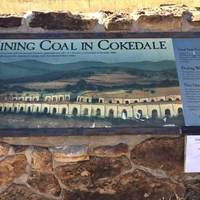 Coke Ovens of Cokedale
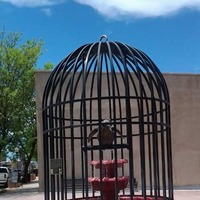 Canary in a Coal Mine Memorial
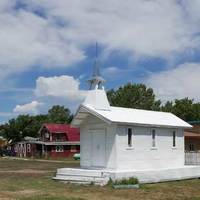 Tiny Church